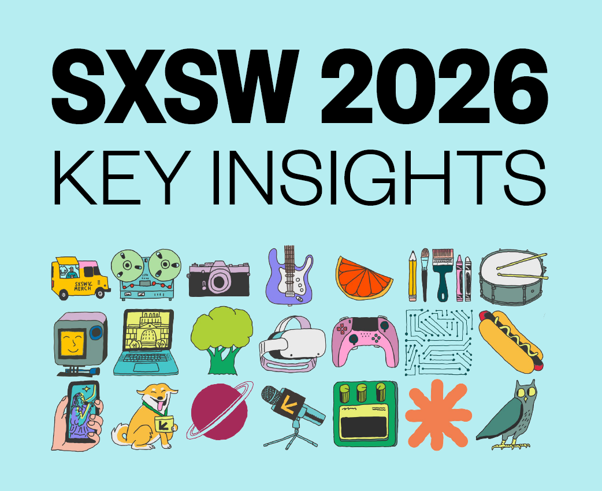
There is something mildly frustrating about SXSW when you do not make it to Austin (Texas) in person. You follow the sessions, the signals, the reactions, the side conversations, the emerging patterns, and you know perfectly well that some of the real value sits in the texture of the event itself. The collisions, the detours, the sessions you did not expect to matter and suddenly do. SXSW, short for South by Southwest, is the annual Austin gathering where technology, business, media, music, film and culture are deliberately thrown into the same pot. That is precisely what has always made it special: it is one of the rare events where emerging technologies are not discussed in isolation, but in direct contact with creators, brands, researchers, investors and society at large. This year (again), my schedule kept me on this side of the Atlantic. I followed SXSW eagerly, sometimes greedily, and yes, with a bit of professional envy for those who were on the ground. But that only reinforced something I have felt for years: SXSW remains one of the rare moments in the calendar that genuinely sharpens curiosity. It predicts the future with rollercoaster accuracy, but because it exposes where technology, business, society and culture are rubbing uncomfortably against each other. That friction is usually where the useful questions begin, and sparks start fires…
That is also why I was particularly interested to read the synthesis put together by my PwC US colleagues. And I do mean colleagues in the most concrete sense. This is not an external analyst note landing anonymously in my inbox. It is fellow PwC teams doing the hard work of going, listening, filtering, debating, comparing notes and then turning a sprawling event into something decision-makers can actually use. PwC’s US team attended more than 100 sessions, engaged with thought leaders, attendees and media, and used AI to help process notes and coverage, while still relying on human judgment to identify what matters most for business and technology leaders. Anyone can scrape noise, very few teams can reduce it intelligently.
What came through most clearly in their recap is that the center of gravity has shifted. Last year’s mood was still marked by optimism around human ingenuity and technological possibility. This year, the conversation is more mature, and frankly more interesting. The report frames SXSW 2026 around a simple but serious idea: the future belongs to the deeply human. That is not a sentimental slogan but a recognition that as AI becomes more powerful, more ambient and more embedded in how organizations operate, the differentiator moves upward. Judgment matters more, trust matters more, distinctiveness matters more. Human discernment matters more. The six insights in the report all orbit that same pressure point.
The first insight is probably the one every CIO and CTO should sit with for a while: technology is moving faster than society is prepared to absorb it. That sounds obvious until you unpack the operational consequences. AI, algorithms, robotics and ambient computing are no longer progressing in neat, sequential waves. They are converging, and that convergence is outpacing governance, institutional adaptation and social readiness. The report also connects that to information integrity and infrastructure strain. It argues that authority is quietly shifting away from people and institutions toward models, platforms and algorithms, often without leaders fully realizing the extent of that transfer. That is the sort of warning serious technology leaders should not read too quickly.
The second insight hits a different nerve, but an equally strategic one. Brands, according to the report, need to embrace creators, culture and the algorithm if they want to stay ahead. I read that less as a marketing observation than as a broader signal about visibility and relevance. We are entering a world where algorithmic distribution increasingly rewards sameness while punishing nuance. In that environment, distinctiveness becomes precious: culture becomes leverage. Authenticity stops being a nice word in a keynote and becomes a practical requirement for cutting through noise. What I like in the way the report frames this is that it does not reduce the issue to content tactics. It recognizes that trust, identity and resonance are becoming strategic assets in markets increasingly flattened by automation and optimization.
The third insight is one I find especially relevant for leadership teams trying to think clearly about AI adoption: be uniquely human. As people use AI as a productivity partner, PwC notes early signals that core skills may begin to erode, which is why organizations and individuals need to actively safeguard capabilities such as strategic vision, inspiration and judgment. That feels exactly right. We are all fascinated by how quickly these systems can accelerate drafting, coding, synthesis and search. But speed is not the same thing as comprehension, and assistance is not the same thing as mastery. The real risk is sadly not just displacement, but skill atrophy disguised as convenience. For leaders, the goal cannot simply be more AI use. It has to be better human performance in an AI-rich environment.
The fourth theme is one many organizations underestimate at their own expense. PwC’s report argues that the workforce is not necessarily resistant to change. What people need is greater trust in leadership. That is a far more demanding diagnosis than the usual lazy complaint about employees being slow to adapt. AI is reshaping daily work, collaboration and expectations, but many leadership narratives still remain too abstract, too top-down and too self-congratulatory. Meanwhile, employees experience the shift concretely, in their tasks, in their uncertainty, in their fear of becoming interchangeable, in the ambiguity about what will still count as expertise. If leadership does not close that trust gap, change programs will stall no matter how sophisticated the technology stack looks on paper.
I also appreciated the fifth insight because it pushes back against one of the most sterile instincts in modern management. You cannot automate mattering. That is such a good line. The report argues that community and lived, human experiences remain essential for health, growth and engagement, and it cites research discussed at SXSW showing that people who receive meaningful feedback are far less likely to be job hunting and far more engaged in their work. There is a lot packed into that idea. We are building astonishing systems of convenience while rediscovering how badly people need to feel significant, appreciated and connected. Any business leader who ignores that tension is going to misunderstand not just culture, but motivation itself.
The sixth and final insight goes further out, but not as far out as many would like to believe. The augmented human is accelerating, and equitable access is not. PwC points to advances in neuroscience, wearable and embedded devices, and brain-computer interaction that are making human augmentation less of a niche concept and more of an emerging social and economic reality. The issue, of course, is not just capability. It is access. It is who gets enhanced, who gets left behind, and what happens to labor markets, education, opportunity and social stability when that divide opens wider. The report quotes Amy Webb warning that opting out may eventually mean falling behind. That is exactly the kind of line SXSW is good at surfacing, it forces leaders to confront the governance and equity questions before the market makes those choices for them.
SXSW still matters to me, even from afar and even with the slight irritation of not being there in person this year. It remains a very efficient antidote to intellectual laziness. It forces us to look beyond our immediate delivery agendas and ask what kind of world our systems are actually helping to build. For someone in my role, that is invaluable. The event still has a rare talent for surfacing the tensions one cannot afford to ignore. And this year, thanks to the work of our PwC US colleagues, I did not have to settle for fragments, clips and social media noise. I could read a synthesis worthy of the effort behind it.
The full PwC SXSW 2026 Insights Report is here: https://explore.sxsw.com/hubfs/2026/2026%20SXSW%20PwC%20Insights%20Report.pdf