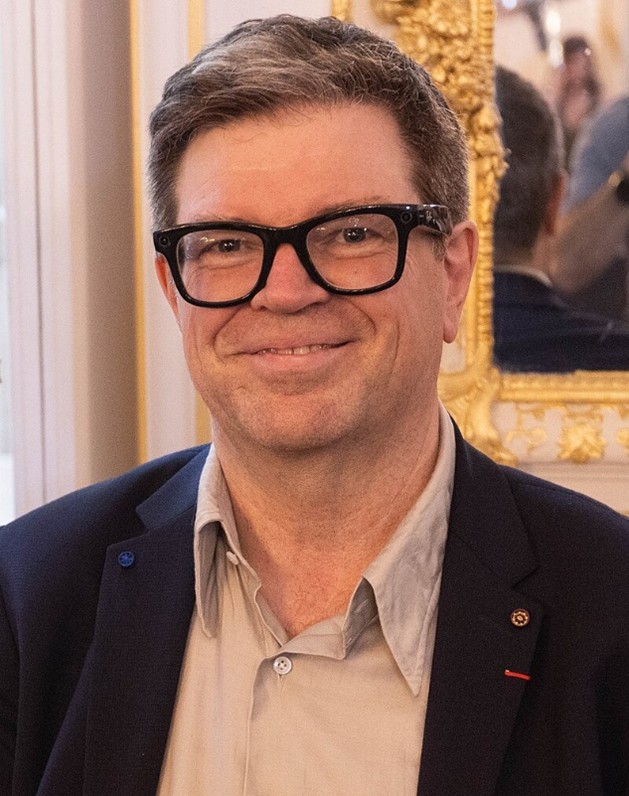
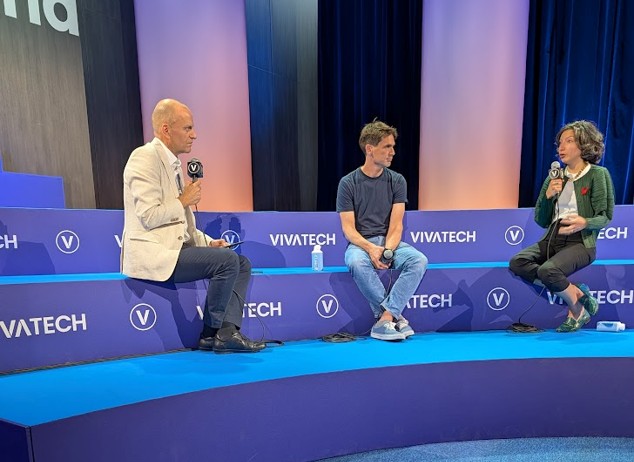
I have spent a lot of VivaTechs in the audience. I take notes, I corner speakers afterwards, I write up what I heard. This year was different. This year I was the one holding the microphone, moderating my first panel, and I will admit the view from the other side of the stage is a very different thing.
The session was titled « Adopting Sovereign AI, from Policy Intent to Enterprise Deployment. » Hosted at the European Centre for AI Excellence space, with PwC proud to be among the first corporates backing that initiative. I had two guests I could not have wished better for: Lucie Finet, Deputy Director of La Mission French Tech, and Stanislas Polu, co-founder and CTO of Dust. One sitting close to policy, one building the product. Exactly the two angles the title promised.
VivaTech is loud with words. Agentic. Sovereignty. Adoption. You hear them everywhere, on every stand, in every corridor. My job for 30 minutes was to slow those words down and ask what they actually mean.
Sovereignty is not a fence
Lucie set the scene with numbers that are easy to underestimate. France now counts around 18,000 startups, representing more than 450,000 jobs. The French Tech mission, attached to the Ministry of Economy, sits inside the machinery of the state and picks roughly 200 strategic companies through the Next40 and French Tech 120 rankings, the latest of which had just been published that very Monday. The role is simple to state and hard to do: clear procedures faster, keep legislation in step with innovation, and carry these companies abroad, because a champion that only sells at home is not a champion.
Then Stanislas reframed the whole conversation for me. Being sovereign for the sake of being sovereign is not the point. The point is to build global leaders. The best version of sovereignty does not draw a border and defend a small territory. It opens up, accepts foreign capital, sells to other markets, and still keeps its centre of gravity at home. Dust raised a great deal of US capital and remains a French top-tier company. Those two facts are not in tension. They are the whole idea.
Lucie picked up a remark she had heard the day before from Germany’s digital affairs minister. When you start from scratch, you have the joy of winning. When you have something to lose, you start being afraid of losing. Europe, the argument goes, has slipped into the second mode. We need to switch back to the first. We have the talent. We have the ideas. The money is harder, but the mindset is the real switch.
Measure your dependencies before you have an opinion
I pushed on the practical side, because that is where I live as a CIO.
Lucie offered the cleanest framework of the afternoon. First, measure your dependencies. There was a report a few weeks back suggesting something like 83 percent of cloud spend flows to US companies. That is the average. The useful question is where you personally stand against it. Second, assess the urgency, and recent events have a way of making that vivid. Third, find the right alternative, with the right level of quality. Sovereignty does not get a pass on excellence. A French solution still has to win on price and performance, and the ones that do simply need more visibility with large corporates. That is the logic behind « Je choisis la French Tech, » the program that now has 23 companies committed to roughly two billion euros of purchasing from startups and scale-ups.
Stanislas took the same idea down to the company level. The first sovereignty is local. As a company, you want the choice of who provides your intelligence, whether that is OpenAI, Anthropic, or open source. He compared it to running a factory machine wired to a single energy source. A bakery oven that only runs on Russian gas, or only on French nuclear, or only on Spanish solar, would terrify its owner. So why accept the equivalent when you buy the layer that sits on top of the models, the interface to your agents and your data? Even if you end up consuming mostly one model today, the flexibility to switch is the thing worth protecting. That is, more or less, the whole product thesis of Dust, and it landed cleanly in a panel thinking about sovereignty.
Intelligence as a factor of production
Stanislas then said something that I keep turning over. We have always accounted for materials and energy as inputs to the economy. We never quite accounted for the third one, intelligence, because for most of history intelligence simply meant population. Now a new form of it has appeared, artificial, and it can be built locally or bought from abroad, exactly like energy. We made strong choices to be sovereign about energy. The same debate is arriving for intelligence, and he was honestly pleased to see it happen, because it means we are starting to price the real impact of this new input. The interesting questions are not about today. They are about where you stand in five years.
Adoption is the harder problem
If sovereignty was the headline, adoption was the part that felt closest to home.
Lucie was candid. The ministry is not the earliest adopter, and she said so with a smile aimed kindly at her own IT colleagues. But she also spends her days with startups and scale-ups, and she has worked inside one, so she knows what the technology can do for speed and productivity. The French Tech 120 are, almost all of them, already deploying AI in one way or another. The gap sits with small and medium businesses, where the questions are quieter and lonelier. How do I start. Do I even have the data to feed a model. Will this actually improve my business. The general manager who feels alone with that decision is, to me, the real adoption story of the next two years, and the state has a role to show those companies what good looks like.
Stanislas offered a contrarian and rather flattering read. On average, he argued, French scale-ups have very good AI adoption, better in places than the US. A year ago Dust was used heavily across Paris scale-ups while equivalent top-tier US names were behind. His hypothesis was cultural. We like to understand how things work. We tinker, we refine, we poke at the machine. Americans tend to want it pre-baked and ready to consume. For consumer products that American instinct is an advantage. For adopting AI, the tinkerer’s instinct turns out to be a real edge. The counterweight, of course, is capital. An American will sign a ten million dollar check to see what happens. The French will try 100k first. Two opposing forces, and somewhere in the friction between them sits a genuine European advantage.
He also told a story about the pace of the technology.. Inside his team they switch models flexibly for coding. Around November 2025 a model reached a level that triggered what he called a phase transition. The job of a software engineer changed materially between that month and January 2026. Not a slow drift. A different job. The models are still jagged, brilliant in some places and brittle in others, but in the good places they are flirting with the top of human capability. Zoom out ten years and the curve is an explosion. Stand inside it and each small jump lands with enormous force.
What I took away
I asked, near the end, for a secret sauce. Lucie gave me one worth keeping. The environment. The patient work of helping talented entrepreneurs find success, and of building real connections between economies so those companies can grow beyond their borders.
That is the line I left the stage with. Sovereignty as ambition rather than defense. Dependency as something you measure before you have an opinion about it. Adoption as a human problem more than a technical one. And a French ecosystem that, somewhere in the last two years, has stopped asking whether it belongs at the table and started behaving like it owns a seat.
My thanks to Lucie and Stanislas for the generosity and the candor, to the European Centre for AI Excellence for hosting, and to everyone who stayed through to the sovereign lunch break. Hosting rather than attending changed how I listened. I suspect I will be asking for the microphone again.